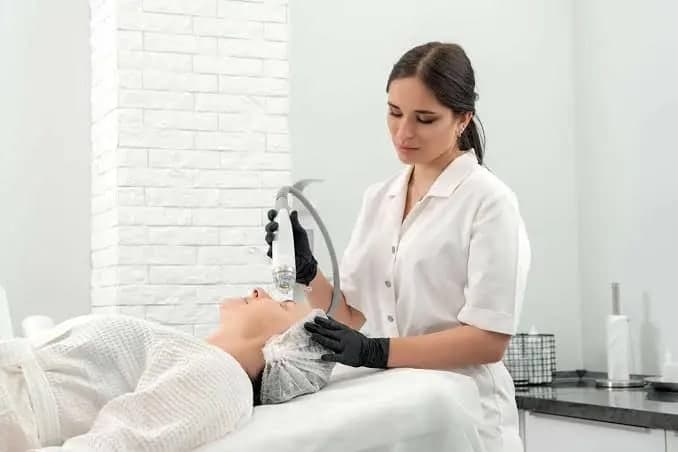
Non-invasive, device-based treatments such as HIFU, carbon laser facials and Nd:YAG laser toning can be delivered safely at home, because the result depends on the device, the settings and the operator rather than on the room. Injectable and medical procedures such as Botox, dermal fillers, deep chemical peels and anything involving IV access belong with a qualified doctor, whether that happens in a clinic or at home. The real question is not location. It is whether the person treating you is qualified for that specific procedure and has a plan for what happens if something goes wrong.
This guide sets out which treatments sit in which category, what at-home genuinely does better, what a clinic genuinely does better, and the eight questions worth asking any provider before you book.
The three tier framework
Most confusion about at-home aesthetics comes from treating "aesthetic treatment" as one category. It is at least three.
Tier
What it covers
Where it belongs
Who should perform it
Tier 1: Non-invasive device treatments
HIFU, carbon laser facial, Nd:YAG laser toning, LED, radiofrequency, non-surgical body contouring
Home or clinic, both workable
Trained and certified operator, with medical escalation available
Tier 2: Minimally invasive
Microneedling, superficial chemical peels, PRP and GFC hair treatment
Clinic preferred, home possible under strict conditions
Practitioner qualified for skin-breaking procedures
Tier 3: Medical procedures
Botox, dermal fillers, deep peels, IV therapy, fat dissolving injections, prescription medication
Requires a qualified doctor regardless of location
Registered medical practitioner only
If a provider blurs these tiers, that is the signal to walk away. A treatment does not become non-medical because it is delivered in a living room.
What at-home genuinely does better
These advantages are real and they are the reason the category exists.
Privacy. No reception desk, no waiting room, nobody you know sitting opposite you. For anyone treating acne, pigmentation or hair loss, this is not a small thing. It is often the deciding factor.
Course completion. Most device-based protocols need four to eight sessions spaced weeks apart. Results depend on finishing the course. In Delhi NCR, the single biggest reason people abandon a course is not cost or discomfort. It is the accumulated friction of travelling across the city eight times. Removing the travel removes the main failure point.
Continuity of practitioner. In a busy clinic you may be assessed by one person, treated by another, and reviewed by a third. Settings drift, notes get thin, and the person holding your file changes. A single practitioner across the full course keeps the protocol coherent.
Scheduling around your life. Appointments fit your day rather than a clinic rota, which matters for anyone whose alternative is not booking at all.
The equipment does not change. For device treatments, the same class of professional equipment is used. What changes is the setting, not the technology.
What a clinic genuinely does better
A guide that only lists the advantages of the thing being sold is an advertisement. These are the situations where a clinic is the better answer, and you should expect any honest provider to tell you so.
Anything requiring a doctor on site. Injectables, IV therapy and prescription treatment need a registered medical practitioner. Some at-home services do provide medical staff. Many do not. Ask directly rather than assuming.
Complex or undiagnosed conditions. If the underlying cause of your pigmentation, acne or hair loss has not been established, you need diagnosis before treatment. That may mean a dermatologist and blood work, not a device. Treating an undiagnosed condition wastes money and delays the real answer.
Emergency response. Adverse reactions to device treatments are uncommon, but burns, blistering and nerve irritation are documented risks when settings or technique are wrong. A clinic has protocols and equipment on hand. An at-home provider should have a written escalation plan and a named doctor to refer to. If they cannot describe it, that is your answer.
Procedures needing sterile conditions. Anything meaningfully skin-breaking or involving vascular access needs a controlled environment. A clean bedroom is not a sterile field.
Established medical history requiring monitoring. Uncontrolled diabetes, immunosuppression, active autoimmune conditions and recent systemic retinoid use are all relative contraindications for treatments such as HIFU. These need proper assessment, not a form filled in at the door.
Treatment by treatment
Treatment
At home
Notes
HIFU facial lifting
Suitable
Non-invasive. Outcome depends on device, depth settings and operator mapping. Check contraindications first
Carbon laser facial
Suitable
Superficial and well tolerated. Requires correct fluence for your skin type
Nd:YAG laser toning
Suitable with care
Effective for pigmentation on Indian skin, but settings must be conservative on Fitzpatrick IV to VI to avoid rebound pigmentation
LED and radiofrequency
Suitable
Low risk profile
Non-surgical fat reduction
Suitable
Device-based contouring. Manage expectations on the number of sessions
Microneedling
Conditional
Skin-breaking. Needs strict sterile technique and single-use cartridges
Superficial peels
Conditional
Depth and agent matter. Deep peels are a medical procedure
PRP and GFC for hair
Conditional
Involves blood draw and injection. Should be performed by medically qualified personnel
IV drips of any kind
Doctor required
Vascular access is a medical procedure. Requires prescription, medical screening and someone able to manage a reaction
Botox and dermal fillers
Doctor required
Medical procedures. In India these should be performed by a qualified doctor
Fat dissolving injections
Doctor required
Injectable pharmacological treatment
Our own at-home range covers face treatments, skin treatments, hair protocols and non-invasive fat loss. Where a treatment needs medical oversight, that is arranged rather than worked around, and stem cell IV therapy is handled under medical protocol rather than as a convenience booking.
Eight questions to ask before you book anything at home
Print this, or paste it into WhatsApp. A provider who answers all eight clearly is worth booking. A provider who deflects on any of them is not.
What exactly is your qualification, and who issued it? Ask for the certifying body, not a job title. "Cosmetologist", "aesthetician" and "beauty therapist" are not interchangeable and are not protected terms in India.
Are you qualified for this specific procedure? Someone excellent at facials is not automatically qualified to operate a Class 4 laser.
What device are you using, and is it the professional model? Ask for the make and model. Consumer grade devices sold under clinical names are common.
What settings will you use for my skin type? On Indian skin, this is the question that separates a good outcome from post-inflammatory hyperpigmentation. If they cannot discuss Fitzpatrick typing, stop.
What are the contraindications, and have you screened me for them? Pregnancy, recent isotretinoin, active infection, keloid tendency, uncontrolled diabetes and immunosuppression all matter.
What happens if I have an adverse reaction? You want a named doctor, a phone number and a written protocol, not reassurance.
Is a patch test being done? For laser work on pigmented skin, this should not be optional.
What is the realistic outcome and how many sessions? Anyone promising a single session transformation is selling something other than a result.
The point of this list is not to make at-home treatment sound risky. It is that the same eight questions should be asked of a clinic. Most people ask none of them in either setting, which is the actual problem.
The Delhi NCR context
Two local factors change the calculation here.
Travel is the hidden cost of a clinic course. A treatment course of six sessions across Delhi, Noida or Gurgaon is six round trips. Priced honestly in time, that is often the largest cost in the course, and it is the cost that causes people to stop at session three, which is exactly the point where a device protocol is doing its work but has not yet shown its result.
Provider quality varies more than price does. The at-home aesthetics category in NCR has grown quickly, and it has grown faster than any standard governing it. Price is a poor filter here, because an unqualified provider with a consumer grade device can charge close to what a certified practitioner charges with professional equipment. Credentials and device specification are the filters that work.
Our clinical science page sets out the protocols behind each treatment, and Srishti's professional background covers certification and training.
What a first appointment should look like
Stage
What should happen
Warning sign
Before booking
Consultation, ideally remote, covering your concern, history and medication
Being sold a package before anyone has assessed your skin
Screening
Fitzpatrick typing, contraindication check, patch test where indicated
No questions about medical history
Protocol
Written plan with session count, intervals and expected outcome
Vague promises, no session count
Setup
Clean prepared room, adequate lighting, power access, equipment set up in front of you
Equipment already assembled and unexplained
Treatment
Settings explained, comfort checked throughout
No explanation of what is being done
Aftercare
Written aftercare, direct contact number, next session scheduled
Aftercare given verbally only
Review
Progress assessed and protocol adjusted between sessions
No review until the course ends
If you would like to see how this works in practice, you can reserve a consultation and go through the assessment stage before committing to anything.
Frequently asked questions
Is at-home aesthetic treatment as effective as a clinic? For non-invasive device treatments such as HIFU, carbon laser and Nd:YAG toning, effectiveness depends on the device, the settings and the operator. None of those change with location, so a properly qualified practitioner using professional equipment achieves the same result at home. For medical procedures involving injection or IV access, a clinic setting with a qualified doctor is the appropriate choice.
Which treatments should never be done at home by a non-doctor? Botox, dermal fillers, fat dissolving injections, deep chemical peels and IV therapy of any kind. These are medical procedures requiring a registered medical practitioner. Anyone offering them without medical qualification is operating outside their scope regardless of where the treatment happens.
Is at-home HIFU safe? HIFU is generally well tolerated, with the most common effects being temporary redness, mild swelling and tingling that settle within hours to days. Serious complications such as burns or nerve irritation are rare and are associated with incorrect settings or technique rather than with the setting. Safety comes from operator training, correct depth mapping and proper contraindication screening, so the practitioner matters far more than the location.
What qualifications should an at-home practitioner have? Ask for the specific certification and the body that issued it, and confirm they are trained on the exact device being used. In India, medical aesthetic procedures such as injectables and lasers carry clear expectations around medical qualification and supervision, so a credible at-home provider should be able to explain both their own scope and their medical escalation route.
Do I need a patch test before laser treatment? For laser treatments on Indian skin, a patch test is strongly advisable. Fitzpatrick type IV to VI skin carries a higher risk of post-inflammatory hyperpigmentation if settings are too aggressive, and a patch test is the simplest way to establish tolerance before treating the full area.
How many sessions will I need? It depends on the treatment and the concern. Device-based protocols typically run four to eight sessions with defined intervals, and results build across the course rather than appearing after one appointment. Any provider should give you a session count in writing before you start.
Can I have treatment at home if I have a medical condition? It depends on the condition. Uncontrolled diabetes, immunosuppression, active autoimmune conditions, pregnancy and recent systemic retinoid use are all relevant to whether a treatment is appropriate and at what settings. Disclose everything at consultation, including supplements, because a full history is what makes screening meaningful.
How do I book a consultation? Call or WhatsApp +91 97735 79126, or use the consultation booking page. Consultations can be done remotely before you commit to any treatment, and we cover Delhi, Noida, Gurgaon, Ghaziabad and Faridabad.
The honest summary
At-home aesthetics is not a lesser version of clinic treatment, and it is not a replacement for medical care. It is the right delivery model for one specific tier of treatment, the non-invasive device work that makes up the majority of what most people actually want, and the wrong model for anything requiring a doctor.
Location is the wrong question. Qualification, device, screening and escalation plan are the right ones. Ask those four things of any provider, in any setting, and you will make a better decision than most people make.
If you are weighing up a treatment and want a straight answer about whether it suits you, that is what a consultation is for. We would rather tell you a treatment is not right for you than sell you a course that will not work.
Related reading: what to check before booking an at-home cosmetologist, why pigmentation comes back, and what the evidence says about IV drips, YAG toning and fat dissolving injections.
About the author
Srishti is a USA IAO accredited and certified non-invasive cosmetologist specialising in regenerative aesthetics, skin rejuvenation and wellness therapies, delivering at-home treatment across Delhi NCR. Read her professional journey or her story.